
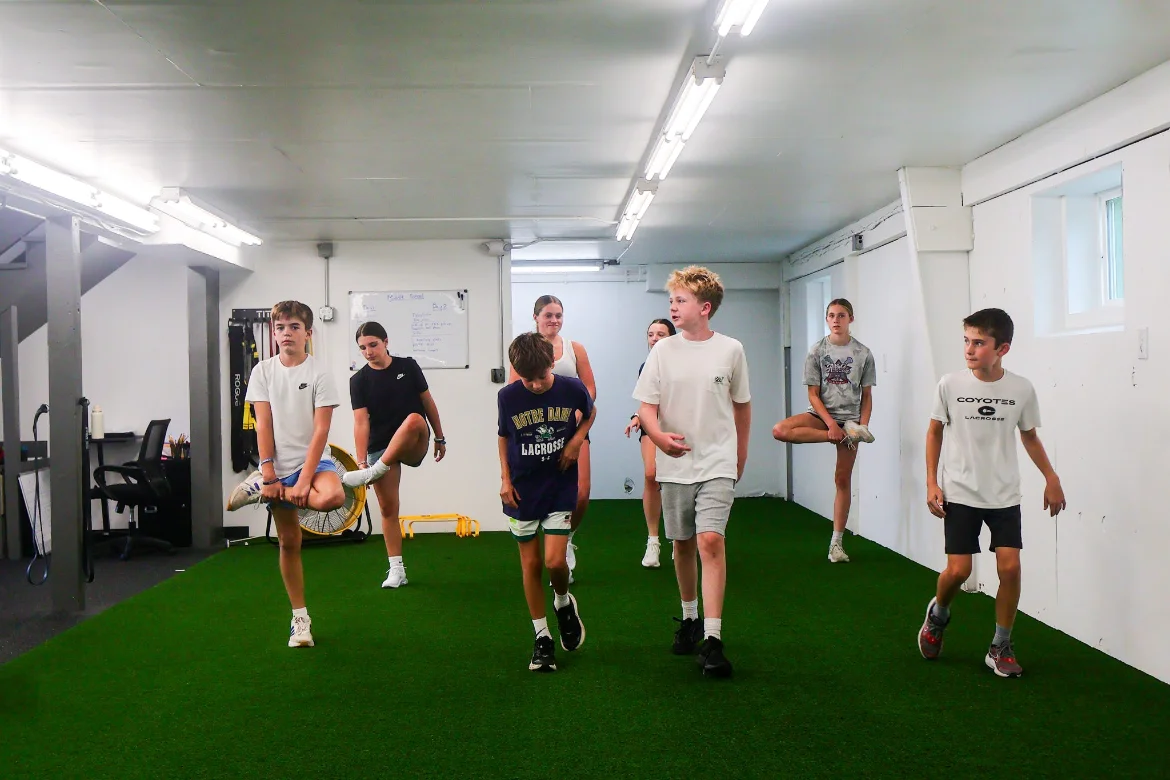
Your middle schooler wants to get stronger, and you want to know whether they’re ready. Maybe they haven’t hit their growth spurt. Maybe they look less coordinated than their friends. You don’t want to rush them into something they can’t handle.
When I meet a new athlete, I’m not looking for a kid who already knows how to lift. I’m looking for a starting point I can coach, a willingness to listen, and a training setting that gives them the help they need.
Parents also ask whether lifting will stunt growth. The American Academy of Pediatrics reports that well-designed resistance training has not been shown to harm growth plates or growth in height. Proper supervision, technique and appropriate loading matter. That is not a promise of zero injury risk. [1]
Start with the child in front of us
Before the first session, I want to know three things: What are your child’s goals? What is their injury history? What do they think their strengths and weaknesses are?
Include current pain, medical restrictions and anything their doctor has told them about exercise. I recommend talking with their doctor before starting, particularly when there are health or injury concerns.
Your child doesn’t need to have college sports in mind. They might want to feel more capable in their sport or simply learn their way around the gym. Those goals help us decide where to begin.
I have no problem giving a child a lighter weight. Being weaker than a friend doesn’t rule them out. Paying attention is a different issue. Can they listen to a demonstration, follow directions and stop when asked? The NSCA also identifies the ability to follow coaching instructions as part of readiness. [2]
What starting from the ground up looks like
One movement I teach often is the hip hinge, which we use when learning a deadlift. Picking something up is a skill your child will use long after a particular sports season ends.
In my coaching, we begin with a PVC pipe. The athlete holds it along their back, with contact at the tailbone, upper back and head. With a slight bend in the knees, they practice moving their hips back while keeping those points of contact. We’re giving them a way to feel the movement before asking them to lift more.
From there, one athlete might use a very light kettlebell. I may put it on a low box so they don’t have to reach as far toward the floor. As their movement becomes more consistent, we might lower the starting height or add a little weight.
That’s an example of how I teach, not a sequence every child needs to follow at home. The starting load, range of motion and next step depend on the athlete I’m watching.
The next repetition tells me more than the calendar
A good first week doesn’t mean we have to make everything harder in week two. I need to see how the athlete is moving now.
Sometimes a short cue helps. Other times I stop a set and bring the athlete back to the PVC pipe. If I’ve moved someone along too quickly, it’s my job to notice and adjust. Going back to practicing a movement is part of learning it.
The words I use can change from child to child. I can’t choose the best cue without seeing what’s happening. I may also change the exercise rather than keep asking a frustrated athlete to repeat something that isn’t working.
Pain needs a different response. If an exercise hurts, stop that exercise and tell the coach. Don’t keep repeating a painful movement to finish the set. Persistent, recurring or concerning pain needs assessment by a qualified healthcare professional. Symptoms of injury or overuse should be assessed before returning to the activity. [1]
An awkward-looking repetition alone doesn’t tell me a child has a structural problem, and being pain-free doesn’t prove an exercise is appropriate. My role is to observe, adjust the training and recognize when we need clinical guidance.
Choose the setting that gives them enough help
A shy child may need help without asking for it. I need to notice that. If an athlete keeps struggling in a larger group, I’ll consider a different exercise, a smaller group or private training with more structure.
Persistent distraction or not following instructions can mean the current group isn’t a good fit. That’s a conversation I have with the parent. Sometimes we change the setting; sometimes waiting makes more sense. The goal is to find the coaching arrangement that works for that child.
Look at the whole week
Tell me about practices, games, other teams and other training. Strength work has to fit alongside those demands.
During a busy season, I’m asking what useful work we can do without leaving the athlete exhausted. The answer may involve less work, different exercises or fewer sessions. Having an open hour on the calendar doesn’t automatically mean another workout belongs there.
As I get to know an athlete, I learn more about their usual energy and mood. If they repeatedly arrive worn out or aren’t acting like themselves, I’ll talk with the parent. That can be hard to judge at first, especially with a quieter child, so communication matters. Sometimes the right adjustment is rest.
Compare them with where they started
I remember a young athlete who initially struggled to control their knees during squats and landings. We spent time on controlled squats and landing practice, adjusting the work as we went. Over time, I saw more control. What stood out was their consistency and willingness to keep learning.
That’s one coaching recollection, not a deadline for another child. Progress doesn’t follow the same schedule for everyone.
Look beyond the weight they lift. Are they setting up with less help? Moving with more control? Understanding a correction? Feeling more comfortable in the gym? Those are useful things to discuss with the coach.
Friends can encourage each other, but I want your child focused on their own progress. We’re comparing what they can do now with where they started, not with the strongest kid in the group.
There will be days when learning takes patience. Showing up and practicing matters, while pain, illness and exhaustion still deserve attention. Commitment includes knowing when to adjust.
If you’re considering strength training for your middle schooler, bring us their goals, injury history and current schedule. At Warrior Sports Performance in Norfolk, MA, we can talk through a starting point and a setting that fit them. You can reach us at [email protected].