
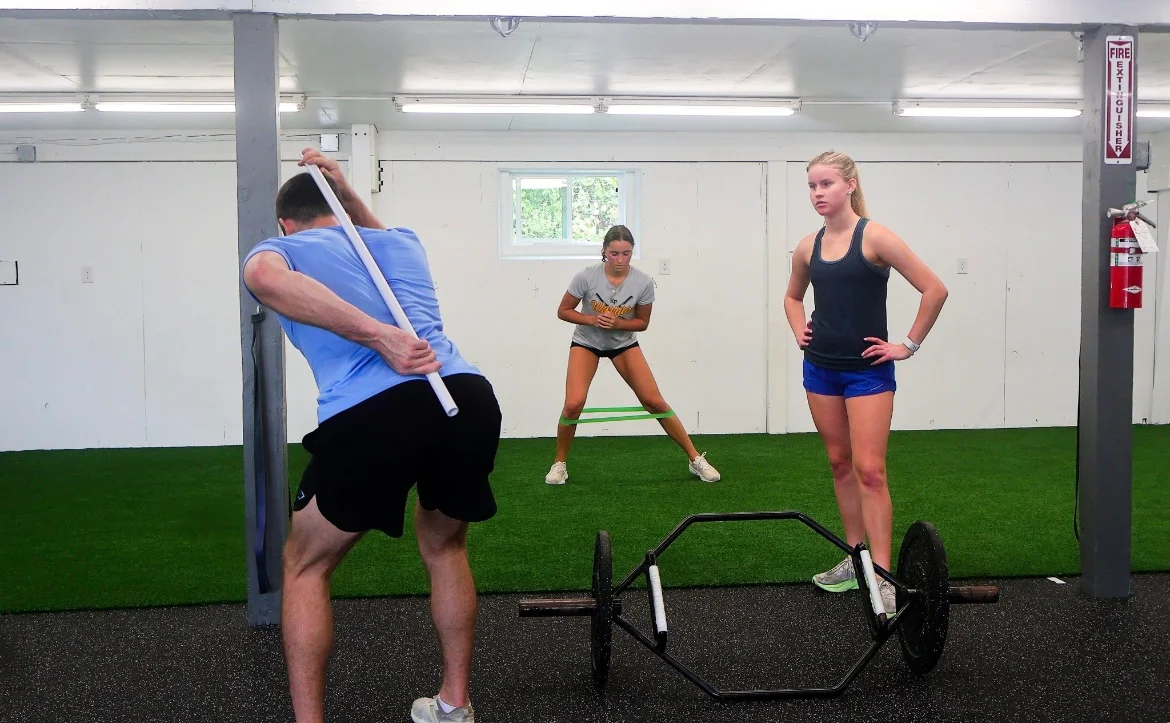
“How do I know the training is working if we aren’t testing a max?”
It’s a fair question. At WSP, I want athletes and parents to be able to see what we’re building—not just take my word for it. But that doesn’t mean testing the heaviest possible squat or deadlift every time someone walks in. We learn a lot from ordinary training: the weights, sets and reps an athlete records, how they move, and what happens across comparable sprint and jump tests.
The workout log tells part of the story
Our athletes follow a program and write down their weights, sets and reps. That gives us something specific to look back at instead of trying to remember whether last month felt harder.
Here’s an example of how that might look on a bench press. An athlete starts with 100 pounds for three sets of five. The following week, the program calls for four sets of five at that same weight. The weight hasn’t gone up, but they’re completing more work—provided the reps still look good.
Later, the program might move to four sets of three, then four sets of two. Fewer reps can give us room to consider a little more weight. That doesn’t mean automatically making every set heavier. I might have the athlete demonstrate a good first set at the familiar 100 pounds, then try 102.5 or 105. If that moves well, we might consider another small increase. If technique starts to fade, we bring it back down.
Those numbers are an illustration, not a four-week plan for every athlete. The point is that we earn the next step. More weight with a shorter movement or a completely different technique isn’t the comparison I’m looking for.
We test often—but not everything, every day
Timed sprints, change-of-direction drills and jump tests are regular parts of our athlete sessions. Depending on the day, that might mean a sprint, a 5-10-5, an L drill or a jump test. We don’t need every test in every workout, and we sometimes skip testing altogether.
Formal strength checks are different. I generally think in terms of a longer training block—roughly quarterly—rather than asking athletes to prove a new max every month. The timing depends on their experience, readiness and sport schedule. Constant max attempts can add fatigue without giving us the kind of information we need to guide everyday training.
Sometimes we use a three-rep performance to estimate a one-rep max and help choose training loads. Multiplying that load by about 1.1 is one rough estimate, not a measured maximum or an exact prescription. It also doesn’t make a three-rep test automatically safer for every athlete. Preparation, technique and supervision matter, and not every athlete needs a maximum test.
Compare the same test with the same test
We use a Brower timing system for sprints, but good equipment is only part of a useful comparison. The setup has to be consistent.
A static 10-yard sprint is not the same test as a 10-yard timed sprint with a flying start. A five-yard buildup is different from a 15- or 20-yard buildup, too. We compare each setup with its own previous results. For change-of-direction tests, we keep the measured distances and test procedure consistent.
For jumps, we currently use OVR jump and pay attention to how the athlete takes off and lands. An unusual reading is a reason to look more closely, not immediately declare a huge personal best. If an athlete usually jumps around 22 inches and suddenly records 29, we check the movement and, when appropriate, repeat the attempt. A repeat can help us evaluate the result; it doesn’t prove the device or the technique was error-free.
A lower number starts a conversation
One slower sprint doesn’t automatically mean the program stopped working. Before changing everything, I ask what the last few days looked like. How did you sleep? What have you eaten? Are you hydrated? How stressful has the week been? What happened at practice—and have you been lifting or sprinting on your own?
That last question matters. An athlete might be doing full-body sessions with me, then add a hard leg workout or max testing elsewhere the day before. I need to know about that work so we can coordinate the whole week, rather than treating each workout as if it happens in isolation.
Sometimes we keep the basic session but reduce the amount of work. Instead of three or four working sets, one or two good sets might be enough that day. In another situation, we might lower the planned load a little. A five-to-eight-percent reduction is one example—not a rule we apply to everyone. The adjustment depends on what we’re seeing and how the athlete feels.
If progress stalls, look beyond effort alone
I do look at intent. Is the athlete concentrating on the broad jump, following the cue and trying to execute the rep well, or just moving through the circuit? Purposeful practice matters. But intent doesn’t mean every exercise is an all-out effort, and a plateau isn’t proof that a kid isn’t trying.
If the effort is there, we look more closely at the movement and the program. On a sprint, that might mean reviewing foot placement or arm action. On a jump, it could mean looking at the snapdown and whether the athlete is losing their position. We also keep recovery and the amount of training in the conversation.
Sometimes changing a familiar movement makes performance feel less automatic for a while. I compare it to adjusting a golf swing: the first few attempts with a change may not produce your best result. That doesn’t mean every lower score is a good sign, though. We still need to watch the trend and reassess whether the change is helping.
Show the athlete what is changing
Video can help make that conversation concrete. We can look at an earlier sprint or jump alongside a recent one and explain what we’re working on. We can also look at other recorded results. If jump height hasn’t improved but the athlete is completing stronger, controlled sets on their bench press or squat, that belongs in the picture, too.
I don’t want to dismiss a goal that isn’t improving. I want the athlete to understand both what is progressing and what still needs work. Better movement, repeatable performance and a useful training record give us more to talk about than one number on one day.
You don’t have to leave every workout exhausted to have done something worthwhile. And you don’t need a new max every week to know where you stand. We’re looking for progress we can explain, repeat and build on—not a test result at any cost.
At Warrior Sports Performance that means coaching the athlete in front of us, keeping track of the work and adjusting when needed. Bring your goals and questions, and we can talk through what a useful next step looks like.
Sources
OVR help • Flight-time measurement research • Estimated 1RM research • NSCA youth resistance-training position statement